
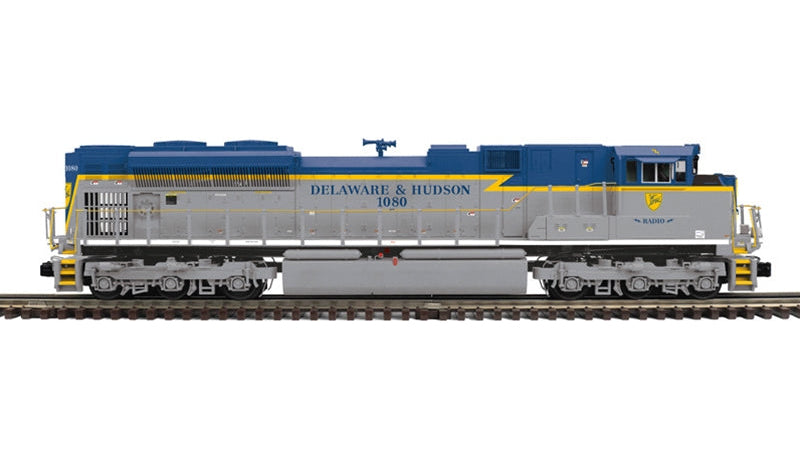

Description
Features:
- Intricately Detailed Durable ABS Body
- Die-Cast Truck Sides, Pilots and Fuel Tank
- Metal Chassis
- Metal Handrails and Horn
- Moveable Roof Fans
- Metal Body Side Grilles
- Detachable Snow Plow
- (2) Hand Painted Engineer Cab Figures
- Authentic Paint Scheme
- Metal Wheels, Axles and Gears
- (2) Remote Controlled Proto-Couplers
- O Scale Kadee-Compatible Coupler Mounting Pads
- Prototypical Rule 17 Lighting
- Directionally Controlled Constant voltage LED Headlights
- Lighted LED Cab Interior Light
- Illuminated LED Number Boards
- Operating LED Ditch Lights
- (2) Precision Flywheel-Equipped Motors
- Operating ProtoSmoke Diesel Exhaust
- Onboard DCC/DCS Decoder
- Locomotive Speed Control In Scale MPH Increments
- Proto-Scale 3-2 3-Rail/2-Rail Conversion Capable
- 1:48 Scale Proportions
- Proto-Sound 3.0 With The Digital Command System Featuring
Freight Yard Proto-Effects
- Unit Measures: 18 1/2” x 2 5/8” x 4”
- Operates On O-42 Curves
Prototype Info:
The DC-motored SD70M-2 and AC-motored SD70ACe are EMD’s hope for the future. While designed to meet the Environmental Protection Agency’s Tier-2 emissions requirements that took effect on January 1, 2005, they also have a higher purpose: to recapture the lead in North American locomotive sales that EMD lost to General Electric in 1987.
Under the hood of both engines beats a third-generation model 710 diesel with 4300 horsepower; only slight modifications were needed to make the model 710 meet new emission standards. With 5000 such motors in service worldwide and a reputation for dependability, EMD reasoned that shop crews would prefer familiar technology.
Other than the prime mover, however, virtually every element of these engines has been re-thought to create a 21st century locomotive. The engines’ angular nose offers the crew far better visibility than most other locomotives, and the cab is comfortable for engineers of almost any size and accommodates a crew of three — an important factor in a modern world without cabooses. Digital screens provide a range of information on what is happening both inside the locomotive and out on the road.
The key difference between the SD70M-2 and the SD70ACe is what’s under the floor: traditional DC traction motors in the SD70M-2’s trucks and AC traction motors in the SD70ACe. While AC traction motors put more tractive effort on the rails and enable an SD70ACe to start a heavier train with the same horsepower, that additional capability comes at a cost. AC-powered locomotives are both more expensive and more electrically complex than engines with DC traction motors, which most diesels have used since the 1940s.
About Atlas O Premier Locomotives:
Atlas O Premier locomotives and rolling stock are highly detailed models that faithfully recreate the prototype down to the paint scheme and even railroad-specific details. They are usually offered in two styles--3-Rail and 2-Rail and come equipped with Proto-Sound 3.0 With The Digital Command System Featuring Freight Yard Proto-Effects. Atlas O Premier Locomotives come in a range of models that cover a variety of eras, so no matter what time period you are modeling, you are getting a fantastic-looking and smooth-running locomotive that will serve you well for years to come.